TIMES AND TIME
Re-sent on 03 May 2026 ("I am re-sending last week's email"); filed under the previous Shabbos, 02 May 2026.
📎 This letter has an attachment (shown below the letter)
Dear Family,
I hope that everyone is well.
Wishing a refuah shleimah to Yechezkiel ben Ester
Mazal Tov to Mendel Kehaty on his upcoming birthday next week. Wishing you a shnas hatzlachah Mendel in both gashmius and ruchnius with much joy and new developments BEH!
Mazal Tov to Shirley Isaacson on her birthday tomorrow. Wishing you a wonderful year Shirley with good health and much happiness! Thanks for keeping in touch!
Mazal Tov to Adam Frankel whose birthday is today. Just realised that you birthday is always erev Pesach Sheni – so nice BH. Wishing you a great year Adam. I hope that all is going well with you and your Family. It would be nice to hear how you are all doing!
I heard a very powerful Dvar Torah this week from Rabbi Shalom Paltiel, on a point in this week’s Sedra Emor, which I would like to share.
It is a bit complex, but I will try and summarise – Please try and get to the end, which has a rich lesson!
The talk is based on the mention of all the Festivals in this week’s Sedra, and is based on a talk by the Rebbe as follows:
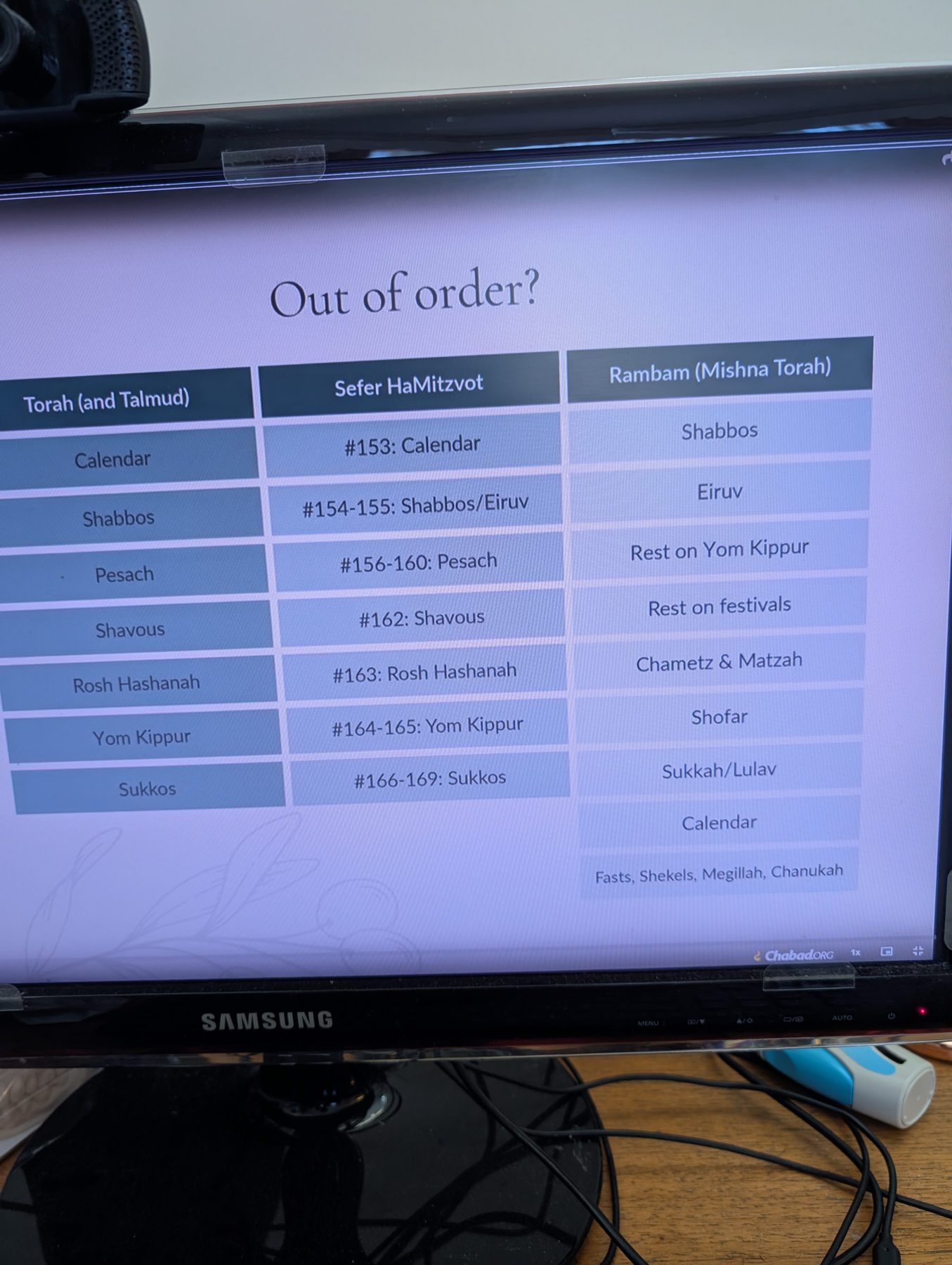
Sedra Emor gives a comprehensive listing of the Festivals, and lists them out in an orderly chronologic fashion ie Calendar, Shabbos, Pesach, Shavuos, Rosh Hashanah, Yom Kippur, and Sukkos.
This same order is followed by the Talmud.
Now the Rambam, in relation to Mitzvos and Jewish Law, wrote 2 books – one was Sefer HaMitzvos, where he listed all the 613 Mitzvos, and one was his ‘Magna Carta’, Mishneh Torah.
In Sefer HaMitzvos, Rambam follows the same order as Torah and Talmud in listing out the Festivals, *but in Mishneh Torah he completely changes the order and uses different terms for the Festivals!?*
Now, anyone who has any knowledge of Rambam’s works will know how precise he is with his words, and how amazing are his organisational skills. So how did this come about?
The Rambam’s order is Shabbos, Eruvin, The rest of the Tenth (Yom Kippur), The rest of the Festivals (general Laws of the Festivals), Chametz Umatzah (Pesach), Shofar (Rosh Hashanah), Sukkah Velulav (Sukkos), Calendar, [Fasts, Shekels, Megilah and Chanukah]
The Rebbe points out the above 2 glaring questions plus 2 more ie the 4 are:
- Changing the order of the Festivals from that of Torah, Talmud, and his own listing in Sefer HaMitzvot? - And changing the names of the Festivals? - Rambam brings the Laws of the Festivals in his Section titled ZEMANIM (TIMES – a general term), whereas the Talmud uses the title for it’s section, Moed (a more focused title meaning Appointed Times) Why does Rambam change the term? - Rambam uses an appropriate verse at the start of each of his 14 Sections to encapsulate that Section. For Zemanim he uses the verse “I have accepted your testimonies as an ETERNAL heritage, for they are the rejoicing of my heart. (Psalms 119:111) This is strange because the Festivals have specific times, and Rambam is expressing eternity. And why bring up joy here when the section is discussing times.
Answer
1. The Magid Mishna (commentary on Rambam) explains that Rambam lists the Festivals *in order of importance (or strictness)*
2. There are 2 ways to look at the obligations for the Festivals. There is the *Festival itself*. And then there is *the person keeping the Festival.* The Festival has a fixed time. But the Jew keeping that Festival has to do additional preparation for that Festival throughout the year. Torah and Talmud are looking at only listing the specific Festivals chronologically, and their fixed times. Rambam who has set out to explain the Laws of how to keep the Festivals (in this case) recognises that there are fixed times*, but for the Jew, his obligation is for the whole year,* and he needs to be guided in *how to do it*, and its order of importance. And the language he uses is according for the person to do (eg instead of Rosh Hashanah, Rambam uses the term The Laws of *Shofar*)
3. Not only do we work on each Festival through the year, but the effects of our work during the Festival carries throughout the year Eg the joy of Sukkos carries forward throughout the year. Similarly the Freedom of Pesach
4. Whenever we do a Mitzvah we not only elevate the article that we are working with. We also elevate that whole species (This could be Inanimate, Vegetable, Animal, Human, Place or TIME). Our actions run a long way. When we do Mitzvos which are time related we *elevate time.* That is why Rambam uses the title TIMES rather than Moed, and speaks about ETERNITY.
Similarly all Mitzvos are eternal, *no matter how small*. It could be merely placing a coin into a Charity box.
Every Mitzvah that we do connects us with an *eternal* unity to Hashem.
Gut Shabbos to all, Gut Pesach Sheni, and a very happy Lag Baomer
Compose:
New Message
[image: Minimise][image: Pop-out][image: Close]
Attached to this letter
The chart “Out of order?” (photo), sent separately six minutes after the letter with “This chart may help understand the Dvar Torah”